


Comms: Starlink ; batteries, use in the heat & change in overseas usage (duration) terms. Top Cover, standards and more.
Starlink : batteries, use in the heat & change in overseas usage (duration) terms.
Starlink is now a very well used piece of tech for remote field operations.

We cover comms and Starlink use on our
R/EMO:TE Medic and Wilderness First Responder courses.
R/EMO:TE Medic is a 5 day course for health care professionals and those holding FREC 4 and above.

The course is a stand alone course but also one module on our 7 module R/EMO:TE Medic Programme.
Our 7 day Remote Medical Responder™️: A Wilderness First Responder Course™️ is a course for non health care professionals
‘Top Cover’ (telemed support) is an essential part of any expedition deployment. It’s not complicated to arrange, it’s not expensive when you split it across an exped team and it’s good practice. Current standards make that clear.
BS:8848:
‘6.7.6.3 The venture provider shall provide a method for the leadership team to communicate during the venture with a medical professional who has expertise relevant to the venture.’
Members of our Faculty were involved in writing current good practice such as BS:8848.
For a useful overview of BS:8848 for remote area medics, from the Faculty of Pre Hospital Care, Royal College of Surgeon’s Edinburgh, see;

Comms are therefore very important for teams where there is no (suitably experienced) health care professional on the actual exped.
Starlink is one aspect of a comms framework.
Sat phone, personal locator beacon and sat tracker/communicator (we like the Garmin Inreach Mini) for part of the framework.
Multiple comms options should be available in the field to cover failure of one system (always plan for multiple redundancy). Your PACE (Primary, Alternate, Contingency, Emergency) plan should accommodate this.


Faculty have used the Starlink Mini from Antarctica, Scandinavia, wild places of the UK to mountaineering in the Canadian North.
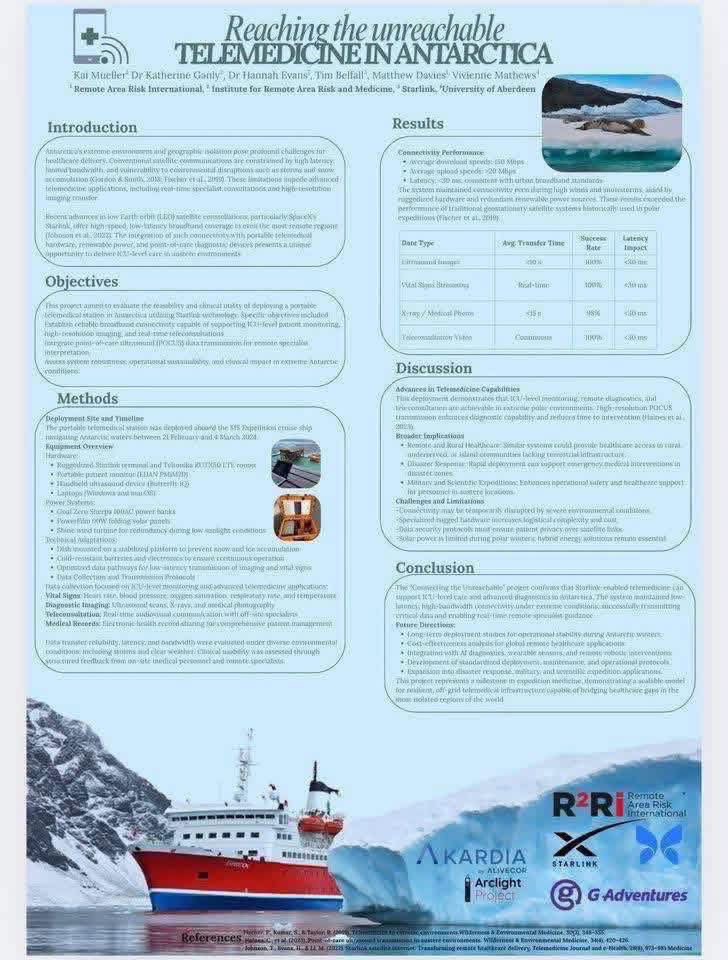
We’ve used other Sat comm systems across the globe. Some of the Faculty are comms specialists with highly specialist comms backgrounds.

Starlink is a game changing piece of kit.
This week, we received an amendment to terms of service (attached) - it seems (we need to check) that the ability to use it for 2 months overseas, has reduced to 30 days, without taking further steps (see the image).

Not sure if ‘Europe’ will be geographical Europe or the EU, but usage in Europe, for those with a unit registered in Europe, won’t count as taking it out of your home country.
Testing, re - testing and testing again. We’ve used a Starlink extensively. We have a favoured battery system and a small, lightweight solar set up (details of both below) to maximise comms duration in the field.

We’ve used this combination for a number of years. It works well and its compact.
Whenever you are preparing for a deployment, don’t assume.
Take recommendations from those who have been there before and used the kit there. In the same context, weather, region.
Better still, do a recce.
We’ve been using Starlink for some considerable time now.
In the early days of the product, Faculty tested it in Antarctica. We’ve had alumni out in the field in Scandinavia, calling in by zoom to us in the UK, using different battery systems; just to check variables, what works and what doesn’t, what battery units are compatible, what software solutions work best.

We’ve recorded several podcasts using starlink - from Antarctica to Scandinavia.
Over the last few weeks, Faculty members were overseas, somewhere hot.
It was 42 degrees C last week. At 19.30 in the evening.
Starlink has worked fine. The unit has been physically hot to touch. Zero operational impact. The 40W solar panel charged the battery pack from flat to fully charged in 12 hours.
At one point, the input into the power pack, via solar, was a third higher than from mains charging. Bonkers.
One of the reasons we use the battery pack we do, is because it will accept solar input at the same times as powering the Starlink (output).
Using solar power to charge the battery pack, whilst Starlink was in use, acted to extend the comms life (dictated by battery life). It’s a nice feature of this battery unit.
This battery unit is also the max size you can take on a plane without permission. Each exped team member carrying one gives a formidable power reserve.
🔋 Each power pack gives us c 3.5 hours starlink use.
We’ve used them extensively on our UK based courses including our Prolonged Field Care courses - in all sorts of weather.
The system works really well.
In the hot weather, direct sunshine, the battery had an overheat warning light - it was that hot.
However, operational operating temps for the battery unit (both charge and discharge) are 0 - 40 degrees C, so it kept on operating in the shade. Keep your batteries cool. Keeping it in the shade (but the panel in the sun) saw the warning light disappear.
What we were using was a light weight, portable set up.
Sat Comms: StarLink mini
Battery: Jackery Explorer Plus 100 https://uk.jackery.com/products/explorer-100-plus-portable-power-station
Solar Panel: Flex Solar 40w https://amzn.eu/d/07MnHRi9
Amazon is shortly to launch its Amazon Leo rival to Starlink.
The Amazon nano is smaller than the Starlink.
Once it’s released, we’ll do side by side comparisons.
Remote Area Risk International:
‘Where Professionals Come To Train’
Prevent | Respond | Rescue | Resolve | Evacuate ™️
Qualified, current, experienced

Comments